 Admin
Admin 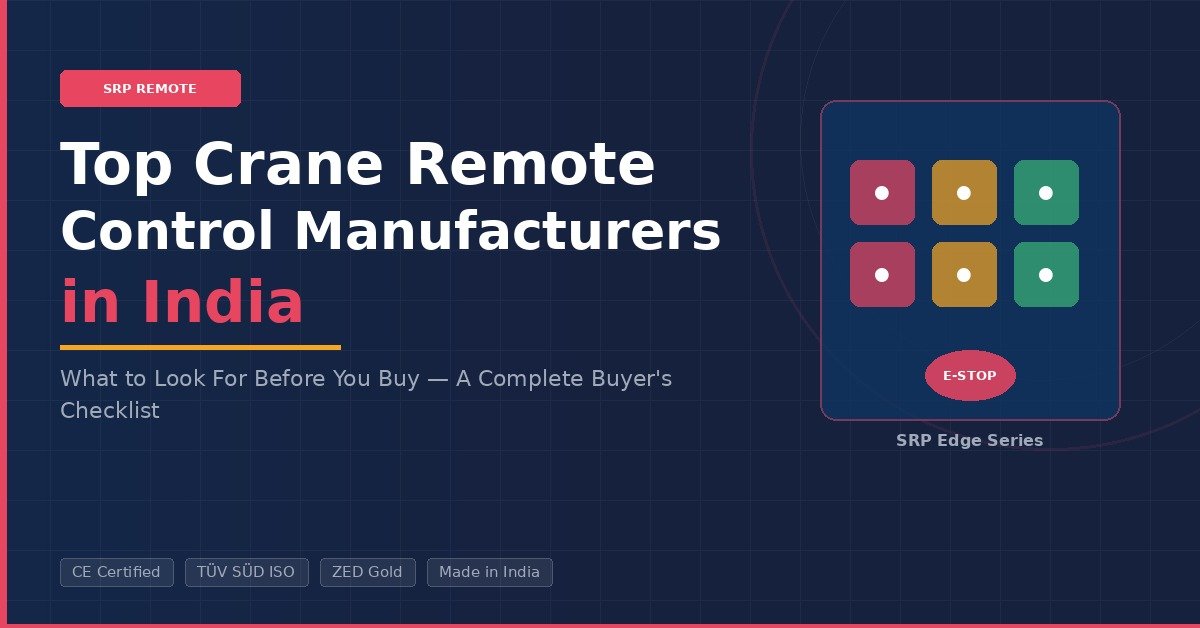
-
Admin
- 30 May 2026
A crane remote control failure in a steel plant, foundry, or warehouse isn’t just an inconvenience. It brings production to a halt and, in the worst cases, creates a safety risk for the operator. The remote control is often the last thing a buyer thinks about when commissioning a crane – and the first thing they regret not thinking about more carefully when something goes wrong.
India has no shortage of crane remote control suppliers. The harder question is: how many of them actually manufacture what they sell? And how many will be reachable six months later when you need a repair?
This guide gives you a straightforward checklist – what to look for, what to ask, and what to avoid when choosing a crane remote control manufacturer in India.
Manufacturer vs Trader – This Distinction Matters More Than You Think
Most buyers don’t realise there are two completely different types of “suppliers” in the Indian crane remote control market.
A genuine manufacturer designs the product, fabricates the PCB in-house, assembles the unit, and tests it before dispatch. They can customise button layouts, remap functions through software, repair any unit they’ve made, and provide spare parts because they stock the components themselves.
A trader imports a finished product – usually from China – rebrands it, and sells it. There is nothing inherently wrong with this, but the implications become clear the moment something needs repairing. The trader has no PCB, no internal knowledge of the circuit design, and no ability to customise. Your repair either goes back to a factory overseas or doesn’t happen at all.
How to verify before you buy:
- Ask for photos of the manufacturing facility
- Ask specifically whether PCB fabrication is done in-house
- Ask who designed the firmware and whether they can modify it
- Ask for a factory visit or a facility walkthrough video
A genuine manufacturer will have straightforward answers to all four. A trader won’t.
SRP Remote designs and manufactures every remote control in-house at our integrated facility in Rajkot, Gujarat – from PCB fabrication and embedded firmware to final assembly and quality testing. See how we manufacture →
Certifications That Actually Matter
Every supplier will mention certifications. The question is which ones are meaningful and whether they were issued by a credible third party.
CE Certification is the baseline for safety-critical industrial equipment. It indicates the product meets European safety, health, and environmental requirements. For crane remote controls, this covers electromagnetic compatibility and low-voltage directive compliance. If a supplier cannot provide a CE certificate, walk away.
TÜV SÜD ISO 9001:2015 is a quality management system certification issued by TÜV SÜD – one of the most respected testing and certification organisations globally. This is not a self-declaration. It means an independent auditor has verified the manufacturer’s quality processes at every stage of production.
IP65 Rating means the enclosure is fully protected against dust ingress and water jets from any direction. For crane environments – foundries, outdoor construction sites, steel plants – IP65 is the minimum acceptable standard. Some products claim IP ratings without third-party testing. Ask for the test report.
ZED Gold is a Government of India quality certification under the Zero Defect Zero Effect scheme. It is particularly relevant for buyers in PSU plants, government projects, and defence-adjacent manufacturing, where vendor qualification requires recognised domestic quality credentials.
ISO 14001:2015 covers environmental management – relevant for manufacturers who want to demonstrate responsible production practices.
One thing to be cautious about: self-declared certifications without a named issuing body. Any supplier can print a logo on a brochure. Ask for the actual certificate document and verify the issuing organisation.
SRP holds CE, TÜV SÜD ISO 9001:2015, ISO 14001:2015, ZED Gold, NSIC, and Startup India certifications. View our certificates →
Key Specifications to Check Before You Buy
Beyond certifications, the technical specifications determine whether the remote control will actually perform in your environment.
Operating Frequency Look for 335 MHz GFSK modulation. This frequency band provides stable signal transmission in industrial environments with high electromagnetic interference – welding equipment, heavy motors, variable frequency drives. Cheaper remotes operating on unregulated frequencies drop signal in exactly the environments where you need them most.
Operating Range Standard operating range for most industrial applications is 100–150 metres. Some systems offer programmable range up to 250 metres for large outdoor gantry cranes or port equipment. Verify whether the stated range is standard or requires configuration.
IP Rating IP65 minimum for any indoor industrial application. For outdoor, foundry, or chemical plant environments, verify whether IP67 or higher is available.
Button Configuration This is where most buyers underspecify. A 6-button remote (6+2 layout) covers a single-motion or two-motion crane – hoist up/down plus one travel direction. A 10-button remote (10+2 layout) is the minimum for a three-motion EOT crane with hoist, cross travel, and long travel. Ordering the wrong configuration means either restricted operation or a replacement order.
Single speed means one operating speed per button. Double speed means each button has a slow-step for inching and a fast-step for full travel – essential for precise load placement in casting shops, automotive press lines, and anywhere heavy loads need to be positioned accurately.
Emergency Stop Type Standard E-stop is a push button that releases when pressed again. A magnetic key E-stop physically locks in the off position and requires the key to restart – preventing accidental restart by a bystander or a second operator. For high-risk environments, the magnetic key type is the safer choice.
Receiver Compatibility Some manufacturers use proprietary receiver architectures that lock you into buying replacement transmitters from the same supplier at whatever price they set. Look for universal pairing architecture that allows software-based transmitter-receiver configuration without hardware dependency.
Not sure which configuration your crane needs? Our team specifies the right remote before you order – no back-and-forth after delivery. Chat with us on WhatsApp →
After-Sales Support – The Part Most Buyers Ignore Until It’s Too Late
A crane remote control in a busy plant gets used every shift, every day. At some point it will need a repair, a replacement button, or a firmware update. Where your supplier is located and what their service capability looks like at that point matters enormously.
Local service availability means the difference between a one-day repair turnaround and a two-week wait for a unit to travel to a distant service centre and back. For plants running on tight schedules, two weeks of manual crane operation is a significant cost.
In-house PCB manufacturing is the key indicator of genuine repair capability. A manufacturer who makes their own PCBs stocks the components, knows the circuit, and can repair or replace the board quickly. A trader who imported the product has none of this.
Warranty terms vary widely. A genuine warranty covers manufacturing defects and component failure under normal operating conditions. Read what’s excluded before you sign – some warranties exclude damage from “incorrect use” so broadly that almost nothing qualifies for a claim.
Software-based configuration means button functions can be remapped without replacing hardware. If your crane setup changes – an additional motion added, an auxiliary function reassigned – a configurable remote adapts without a new purchase.
SRP has service branches in Rajkot, Ahmedabad, Faridabad, Bangalore, and Pune. Wherever your plant is located, service support is close. Find your nearest branch →
8 Questions to Ask Any Crane Remote Control Manufacturer Before You Order
Use this checklist when evaluating any supplier. The answers will tell you more than any brochure.
1. Do you manufacture in-house or source from a third party? The answer determines whether they can repair, customise, or support what they sell.
2. Can I visit your facility or see a factory walkthrough? A manufacturer with nothing to hide will say yes immediately.
3. Which certifications do you hold and who issued them? Ask for the actual certificate documents, not just logos on a website.
4. What is the operating frequency and what interference protection does the system have? Relevant for plants with heavy electrical equipment nearby.
5. What is the warranty period and what exactly does it cover? Read the exclusions, not just the headline duration.
6. How long does a typical repair take and do you stock spare PCBs? This question immediately reveals whether they manufacture or trade.
7. Can the remote be configured for my specific crane layout? Software configurability matters if your crane setup is non-standard.
8. Do you have a service presence in my city or region? Branch network matters when downtime costs money every hour.
SRP answers yes to all eight. We’d rather you ask us these questions upfront than find the answers after a failure on the shop floor.
Choosing Right the First Time
The right crane remote control manufacturer is not the cheapest option in the search results. It’s the one that can demonstrate their manufacturing process, back every product with credible third-party certifications, spec the right configuration for your application, and support you after the sale.
India has genuine manufacturers capable of all of this. The checklist above helps you find them – and avoid the ones who can’t answer the hard questions.
If you’re currently evaluating suppliers for your plant or project, we’re happy to be on that list.
Tell us your crane type, number of motions, and operating environment – we’ll recommend the right model and send you a spec sheet within 24 hours.
Get a Free Recommendation on WhatsApp → Send Us Your Requirement →