 Admin
Admin 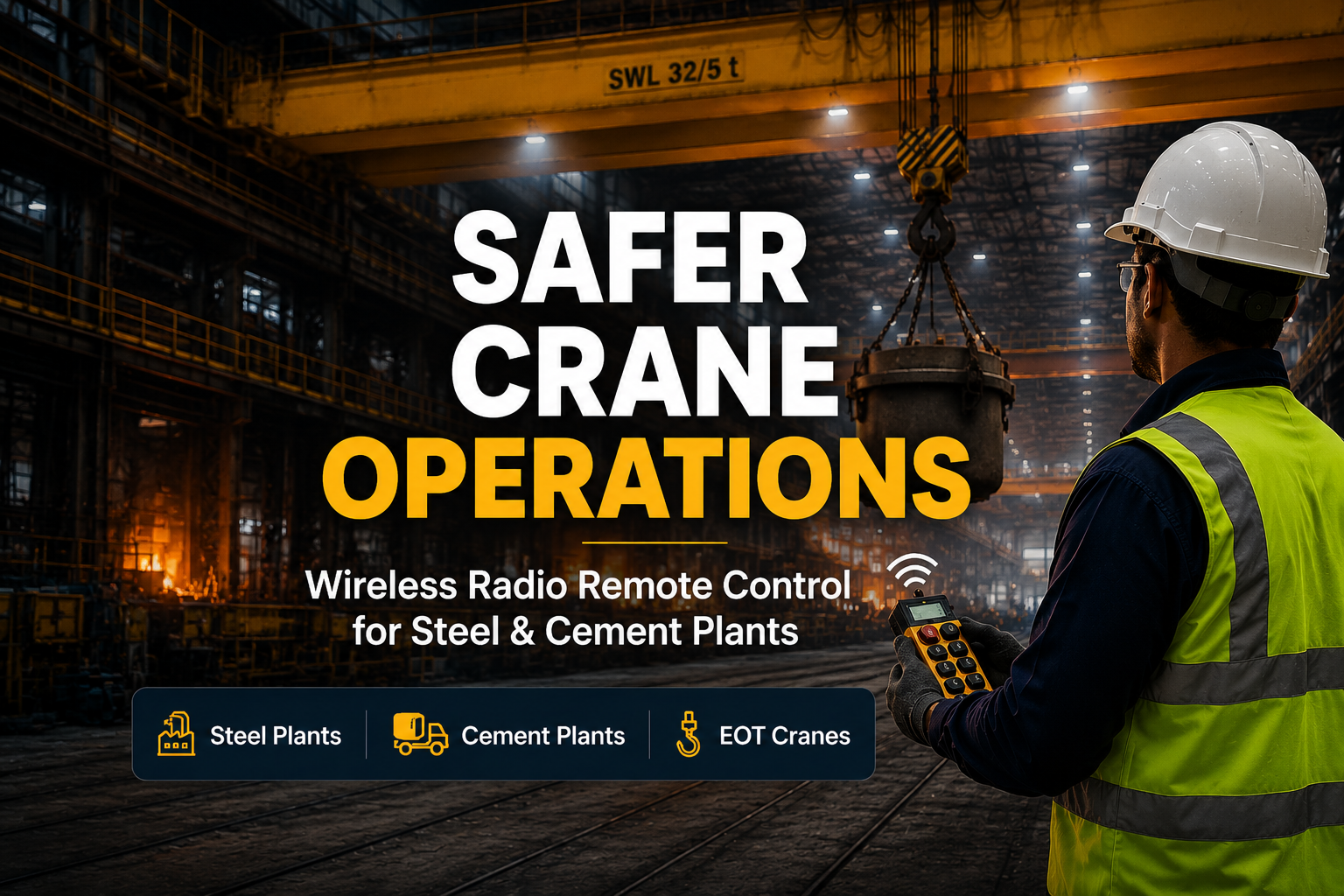
-
Admin
- 15 June 2026
Industrial accidents involving overhead cranes remain one of the most serious safety risks in India’s heavy manufacturing sector. In steel plants and cement factories, crane operators often work close to molten metal, moving machinery, dust, heat, and confined spaces. A single mistake can lead to severe injury, equipment damage, or production shutdowns.
In recent years, many Indian industries have started replacing traditional wired pendant controls with wireless crane radio remote control system. This shift is not only improving productivity – it is also reducing workplace accidents and helping companies build safer operations.
The human cost of crane accidents in India
Crane-related accidents in India’s industrial sector are often caused by poor visibility, operator fatigue, communication errors, and unsafe positioning of workers near moving loads. Steel and cement plants are especially vulnerable because cranes operate continuously under extreme conditions.
According to industry safety studies, a large share of industrial lifting accidents involve operators standing too close to suspended loads or hazardous zones. Traditional pendant systems force operators to remain physically connected to the crane through a cable, limiting movement and visibility.
This is where crane remote control safety India solutions are making a major difference.
Why steel and cement plants are uniquely dangerous for crane operators

Steel plants: operators work near molten metal, high temperatures, sparks, and moving heavy loads. Visibility is often blocked by structures, smoke, or heat haze. Even a small delay in reacting to load movement can be dangerous.

Cement plants: operators face dense dust, vibration, heat, and large material-handling equipment. Overhead cranes move clinker, raw materials, and maintenance components across busy work zones.
These conditions create several industrial crane hazards India companies must manage:
-
Limited visibility around loads
-
Restricted operator movement
-
Risk of getting trapped near machinery
-
Communication delays between ground staff and operators
-
Fatigue from long operating hours
The root cause: why pendant controls put operators in harm’s way
Traditional crane pendant controls require the operator to stand near the crane and remain connected by a cable. While this method has been used for decades, it creates several safety problems:
-
Operators must stay close to the load – the cable length limits how far the operator can move, often forcing them into hazardous areas.
-
Poor visibility – standing directly beneath or beside a load can block the operator’s view of obstacles and workers.
-
Entanglement risks – pendant cables can snag on equipment, structures, or materials.
-
Slower emergency response – if danger appears suddenly, the operator may not be able to move away quickly.
-
Ergonomic strain – holding and dragging heavy pendant units for long shifts contributes to fatigue and reduced alertness.
Many crane accidents steel plant India investigations trace back to unsafe operator positioning and limited visibility — two problems directly addressed by wireless remote systems.
How radio remote control improves crane safety

Modern radio remote control EOT crane systems allow operators to control overhead cranes wirelessly from a safe location with a clear view of the load and surroundings.
Key safety benefits
-
Safe operating distance Operators can stand away from suspended loads, molten metal, and moving machinery, reducing the chance of crush or burn injuries.
-
Better visibility Wireless control lets operators choose the best viewing angle, improving load placement accuracy and reducing collisions.
-
Faster reaction time Operators can move freely and respond quickly to hazards or unexpected load movement.
-
Reduced cable hazards Eliminating pendant cables removes entanglement and tripping risks.
-
Improved communication Operators can position themselves closer to ground teams while staying out of danger zones, improving coordination during lifts.
-
Lower fatigue Lightweight handheld transmitters reduce physical strain, helping operators stay alert during long shifts.
These advantages make wireless systems a strong tool for wireless crane control accident prevention in heavy industry.
Steel plant use case: protecting operators near molten metal

In steel plants, ladle cranes and overhead cranes transport molten metal between furnaces, casting areas, and processing lines. Temperatures can exceed 1,500°C, and operators traditionally had to work close to these dangerous zones.
By adopting radio remote controls, steel plants have been able to:
-
Move operators away from heat exposure
-
Reduce the risk of burns from splashes or sparks
-
Improve visibility during precise ladle positioning
-
Allow operators to work from protected platforms or control zones
Some facilities also integrate remote systems with cameras and safety interlocks, creating multiple layers of protection. This approach is becoming a best practice for crane remote control safety India in metal manufacturing.
Cement plant use case: safer crane operation in dust and heat

Cement plants use overhead cranes for maintenance, material handling, and equipment movement. Dust accumulation and high temperatures can make pendant operation difficult and unsafe.
Wireless remote control helps by:
-
Allowing operators to stand in cleaner, cooler locations
-
Reducing exposure to airborne dust and vibration
-
Providing better sight lines around large equipment
-
Enabling safer coordination during maintenance lifts
This is especially valuable for overhead crane safety cement industry operations, where visibility and mobility are critical.
India’s safety regulations and industry expectations
Indian factories are governed by safety laws and standards that require employers to provide safe lifting equipment, proper operator training, and risk reduction measures. While regulations may not mandate wireless controls specifically, they do require companies to minimize hazards and adopt safer operating practices.
Industry audits and insurance assessments increasingly view wireless crane control as a proactive safety upgrade, especially in high-risk environments like steel and cement plants.
The productivity bonus: safety upgrades that also improve operations
One reason adoption is accelerating is that radio remote systems improve efficiency as well as safety.
Operational benefits include
-
Faster load handling
-
More precise positioning
-
Reduced downtime from cable damage
-
Better operator mobility
-
Improved maintenance access
In many plants, managers find that safer crane operation also leads to smoother workflows and fewer production interruptions.
What to look for in a crane radio remote system
For steel and cement applications, the system should be designed for harsh industrial environments.
Important features
-
Industrial-grade durability – resistant to heat, dust, vibration, and moisture.
-
Reliable radio communication – stable signal performance with minimal interference.
-
Emergency stop function – instant shutdown capability for unsafe situations.
-
Long battery life – suitable for continuous industrial shifts.
-
Ergonomic design – comfortable handheld controls for extended use.
-
Safety certifications – compliance with relevant industrial safety standards.
Plants upgrading from pendant systems should also invest in operator training and updated lifting procedures.
Conclusion
Crane accidents in India’s steel and cement industries are often linked to unsafe operator positioning, poor visibility, and hazardous working conditions. Wireless radio remote control EOT crane systems directly address these problems by allowing operators to control cranes from safer, clearer locations.
The result is fewer accidents, better operator protection, and more efficient material handling. For companies looking to reduce industrial crane hazards India while improving productivity, crane radio remote control is proving to be a practical and effective upgrade.
Improve Crane Safety with SRP Remote
Looking to improve crane safety, reduce operator risk, and increase productivity in your steel plant, cement factory, or industrial facility?
SRP Remote provides reliable industrial wireless radio remote control systems designed for overhead cranes, EOT cranes, hoists, and other material handling applications. Our solutions help operators work from safer positions while maintaining precise control in demanding environments.
Whether you’re upgrading from traditional pendant controls or planning a new crane installation, our team can help you choose the right remote control system for your application.
Call us today: +91 82009 59593
Visit: https://srpremote.com/
Talk to our experts to find the right wireless crane control solution for your industry and create a safer, more efficient workplace.
FAQ
What is a crane radio remote control system?
A crane radio remote control system is a wireless device that allows operators to control an overhead crane from a distance using a handheld transmitter and receiver.
How does wireless crane control improve safety?
It allows operators to move away from suspended loads, heat, dust, and moving machinery while maintaining a clear view of the crane and work area.
Is radio remote control suitable for steel plants?
Yes. It is especially useful in steel plants because it reduces operator exposure to molten metal, extreme heat, and restricted visibility.
Can wireless crane control help in cement factories?
Yes. Cement plants benefit from reduced dust exposure, better mobility, and safer positioning during maintenance and material handling.
Do wireless crane systems replace operator training?
No. Operators still need proper training in crane operation, lifting procedures, and emergency response. The wireless system is a safety enhancement, not a replacement for training.
What features are most important in an industrial crane remote?
Key features include durability, reliable signal performance, emergency stop capability, long battery life, ergonomic design, and compliance with industrial safety standards.